
Erie Resident Lookup Records by Question
There is no verified all-purpose Erie resident register. Each official source can answer a limited question, and none should be assembled into a new person profile. The Erie County property search is a place and parcel starting point. The UJS Web Portal is a court-docket route. Erie County and Commonwealth offices handle marriage, probate, vital, and other record types under their own rules. A careful Erie research note records both what a source can show and what it cannot establish.
| Record | What It Confirms | Where | Access |
|---|---|---|---|
| Property and parcel record | Place, parcel, taxing context, and map navigation, not current residence or public owner data | Erie County Property Tax Search | Public base search; owner display is gated |
| Court docket | Court-provided docket metadata, subject to policy, not a factual finding | UJS Web Portal | Public routes subject to judiciary policy |
| Marriage or probate record | A defined Erie County record request or court process, not a general name index | Erie County record information | Custodian process and published conditions |
| Historic obituary reference | Newspaper-publication reference, not a vital certificate | ECPL obituary service | Public index and request service |
| Current vital certificate | Only through the State’s defined eligibility route | Pennsylvania death certificates | Application, identification, fee, and eligibility rules |
Start with the question, not a broad sweep of sources. A historic-address question belongs with dated directories, maps, and recorded-land research. A court question begins with the court system. A marriage, probate, or certificate request goes to its named custodian. The route protects the reader from treating an index hit as proof of identity, present residence, ownership, or legal outcome.
Choose an Erie Records Custodian
For one historical person, ECPL directories, newspapers, or the obituary index can supply a dated lead. The next step is the appropriate Erie County, Commonwealth, archive, or court custodian for the record type. For one address, begin with Erie County’s property and parcel pathway, preserve the returned situs form and parcel reference, then consult the Recorder of Deeds for an authorized instrument route. That sequence documents a place across time. It does not demonstrate that someone currently lives there.
For a civic question, the Pennsylvania voter registration status route is an individual status check, not a general people search. State election law also has a formal voter-list request process with certification and use limits. For an Erie question, Erie County election staff are the local routing office. Do not treat either path as material for a public roster.
Note: A same-name result remains uncertain until a permitted source supplies matching, non-sensitive details for the specific question.
Check Erie Court Dockets Through UJS
The Pennsylvania UJS Web Portal is the statewide public path for court docket research. Its documented controls include court selection, docket number or other-criteria search, organization, last and first name, date of birth, participant role, county, docket type, case category, case status, and filed-date range. Live controls can change, so confirm the active form before relying on a field. Erie custodian follow-up differs by record: the Clerk of Courts maintains criminal case records, and the Prothonotary maintains civil records and related filings.
The Pennsylvania judiciary’s public-record policies govern the online route alongside the portal. A docket can identify a court action and status shown by the court, yet a name match still needs permitted, non-sensitive corroboration. Full files, images, transcripts, certified copies, and older material can require the courthouse custodian and its fee or access process. A court result does not prove someone’s current Erie address, and an omitted search result does not prove that a record never existed.
| Court selection | Choose the appropriate court context before interpreting a search result. |
|---|---|
| Other criteria | Documented options include party name, date of birth, participant role, Erie County, case category, status, and filed dates. |
| Result vocabulary | A public view may identify docket number, court or Erie County, participant label, filed date, category, status, and a court-provided sheet or summary link. |
| Access boundary | Remote visibility varies under judicial policy. Confidential, sealed, expunged, or limited-access material is not an omission to work around. |
- Docket
- A court’s index or record of a case’s filings and events. It is not a narrative finding that every allegation is true.
- Index and image
- An index identifies a record or entry; an image is the record copy itself, which may have a different access rule.
- Certified copy
- A copy issued by the responsible custodian with the certification required for the purpose at hand.
Use Erie Vital and Family Records Carefully
Erie County guidance separates early local material from current Commonwealth certificates. It lists City of Erie births from 1888 to 1905 and City deaths from 1894 to 1905 at Hagen History Center. Erie County births and deaths from 1893 to 1905 are routed through the Clerk of Records. Erie marriage records from 1885 to the present are routed through the Marriage Records office, while probate records from 1823 to the present are routed through the Register of Wills. Coverage statements do not promise a complete online name index.
The Erie County Marriage License Bureau page sets out the copy-request route and office context rather than a searchable public registry.
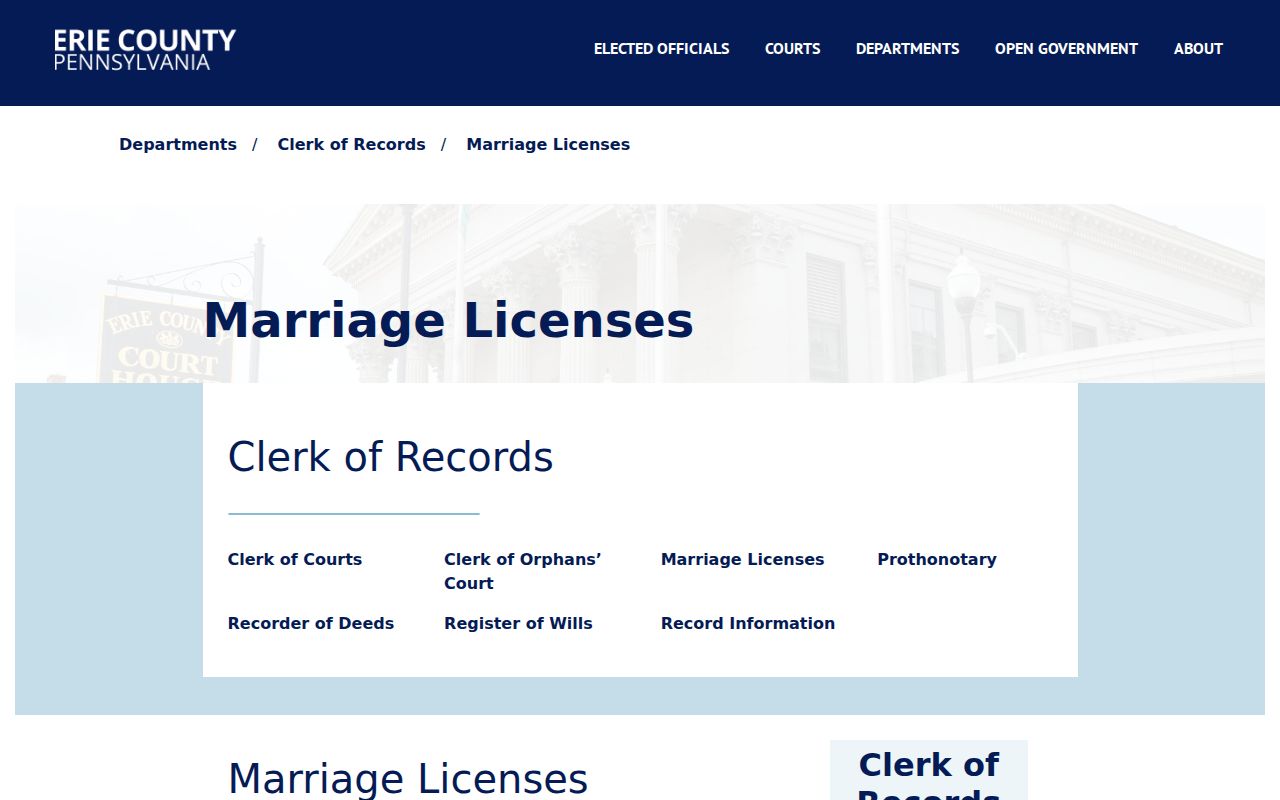
A request for a marriage copy needs the marriage date and both applicants’ full names, including maiden-name detail where applicable, together with the office’s stated fee and mailing materials. Current birth and death certificates from 1906 forward belong to the Department of Health’s eligibility, application, identification, and fee process. An archive index is not a current certificate service.
Adoption material requires a separate stop. Erie’s Register of Wills says adoption records are impounded or sealed by law, and the Department of Health provides a controlled pathway for eligible adoptees or qualifying descendants seeking permitted noncertified original-record information. A personal record search cannot infer, locate, or publish sealed information. For historic vital research, consult the State Archives by event date and record type, then confirm the current release cohort and available index or image route before treating an historic item as open.
Confirm Erie Historical Obituary References
ECPL’s obituary index has documented fields for surname, given name, middle name, and obituary date. The library instructs visitors to use no more than two search terms, and its results are organized by last name, first name, and obituary date. That date is the newspaper publication date. It is a useful way to locate a source citation, but it is not proof of the date of death or a replacement for a certificate.
When a search produces a likely reference, preserve the spelling, newspaper date, and query terms. Request the source material or check the corresponding microfilm before connecting it to a dated Erie record question. This added step is especially important for common names, where a shared surname and a nearby date may still refer to different people.
Keep Erie Record Systems Separate
Some official tools serve a narrow public purpose. The Pennsylvania Department of Corrections locator covers people in State custody and individuals under Department supervision. It does not replace an Erie County-facility roster, and no official Erie County jail name-search interface was located in the reviewed Erie County pages. A no-result in one system is not proof that a record never existed.
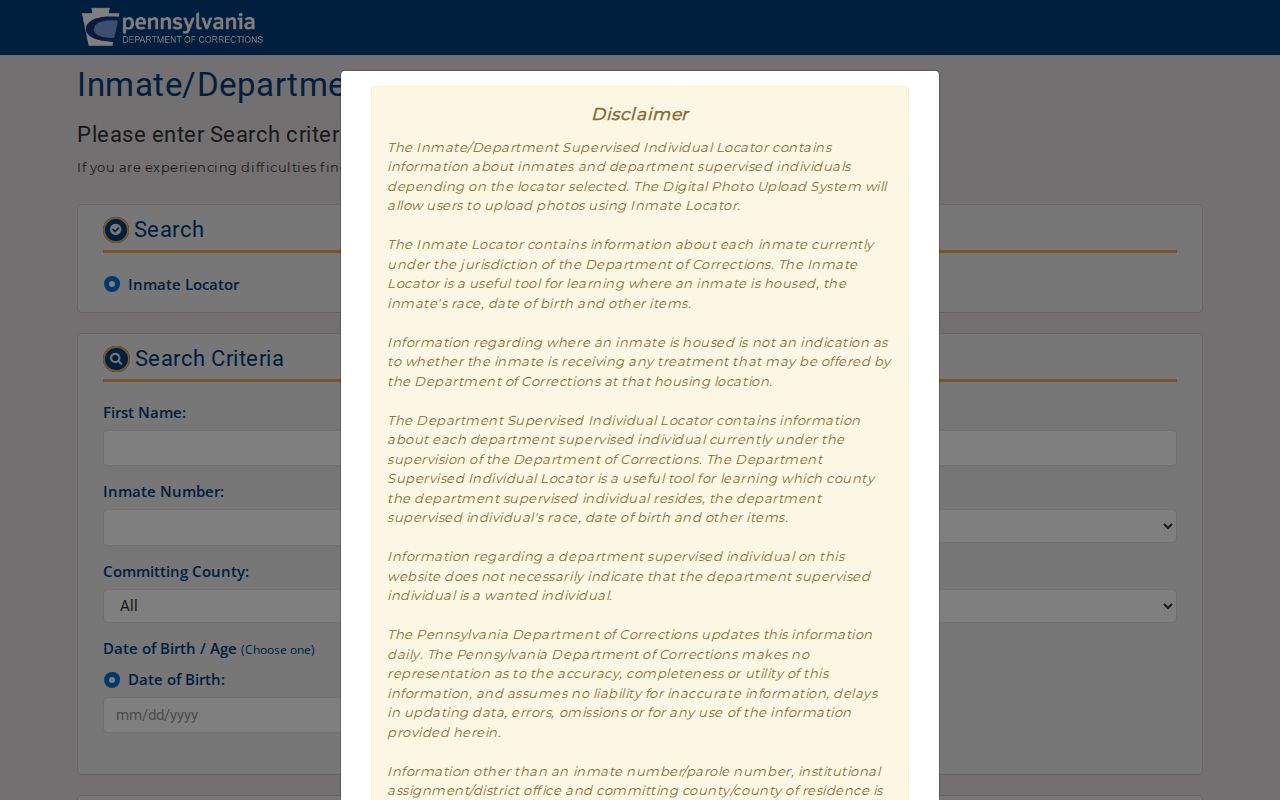
The locator’s documented filters include name components, inmate or parole number, gender, committing Erie County, location, citizenship, and date-of-birth or approximate-age choices. Those filters describe the State system’s scope. They do not authorize combining custody material with court, address, voting, vital, or archival records into a resident profile.
Note: Use a system only for its stated record purpose, then contact the named custodian when a permitted official record requires more context.
Erie Record Access Changes
Erie record access changes with the system that keeps the record. The Prothonotary announced a case-management change effective April 15, 2024, while noting that most current records are electronically scanned and older books or microfilm can need different handling. The Register of Wills announced a paperless CourtPro transition beginning March 3, 2025 and cautioned that filings and dockets after that change are not in INFOCON. Date-aware research keeps an older access path from being mistaken for a current one.
For an office-held record, identify the specific record type, date range, and custodian. The Erie County says the public may search independently and lists a $20 staff record search. That is a more precise fallback than trying to force a broad name query through a portal that does not cover the needed material.
Privacy Limits for Erie Record Searches
Pennsylvania’s Right-to-Know Law, 65 P.S. §§ 67.101–67.3104, applies to many executive and local-agency records, not to every court, vital, investigation, or protected record. A defined request to Erie County can identify the agency, record type, time period, and preferred delivery method. It cannot bypass judicial access policy, a sealed adoption, vital-record eligibility, or other statutory limits. Courts must follow judiciary policy; vital records follow Department of Health rules; election records have their own State and Erie County process.
Pennsylvania’s Address Confidentiality Program is the official route for eligible people who need an alternate mailing-address process. Source corrections also belong with the underlying custodian, such as Assessment, the Recorder, a court office, Vital Records, or Elections. Protecting those boundaries is part of a responsible records search.
When a record link, transcription, or historical citation is wrong, keep the correction request narrow: identify the source URL, field at issue, correction, authoritative support, and a safe contact method. Do not send identity documents through a general contact channel. A credible privacy or safety concern calls for prompt suppression while the source and request are reviewed. The correction of an underlying government record remains with the office that created or maintains it.
Lawful use. Use Erie record routes for lawful, personal research only. Pennsylvania’s stalking statute, 18 Pa.C.S. §2709.1, reinforces that material may not be used to monitor, threaten, harass, or target anyone.