
Erie Directory Collections
The Erie County Public Library Heritage Room at Blasco Memorial Library is the documented starting point for Erie city directories. Its holdings statement says Erie directories begin in 1853. The materials are noncirculating and used on site, so a directory citation should identify the edition actually consulted. ECPL does not publish a complete annual inventory on that holdings page. A missing year in a search note can therefore mean that the edition has not yet been checked, not that Erie lacked a directory that year.
| Collection | Years | Where Held | Access |
|---|---|---|---|
| Erie city directories | Begin in 1853 | ECPL Heritage Room, Blasco Memorial Library | Noncirculating, on-site |
| Suburban and Millcreek directories | Begin in 1957 | ECPL Heritage Room | On-site collection |
| Erie newspapers on microfilm | 1820 to 2018 | ECPL Heritage Room | On-site readers and request conditions |
| Erie County census microfilm | 1800 to 1930 | ECPL Heritage Room | On-site historical research |
Keep the Erie City and suburban series separate. The documented 1957 starting point for suburban and Millcreek material does not mean an Erie City address appears there, and an Erie directory does not stand in for a suburban edition. Collection descriptions establish starting points, not uninterrupted runs or a promise that each volume has the same sections.
Erie Directory Research at ECPL
The Heritage Room pairs its Erie directory shelf with maps and atlases, a local vertical file, yearbooks, census material, and historical newspaper resources. Its newspaper microfilm range reaches from 1820 through 2018. Five reader-printers are available, with free scans to USB and a published per-page copying charge. Some database access is limited to a library card or in-library use. Those conditions make the room a useful place to verify a title and year rather than a basis for assuming that every collection can be searched remotely.
For a dated person or household reference, copy the title, publication year, page, spelling, street direction, and nearby cross street exactly as printed. The ECPL obituary index is a companion source, not a substitute for a directory volume. Its date is the newspaper publication date, which may differ from the date of death. A source copy or the original newspaper gives the context needed to assess a match.
ECPL also identifies historical newspaper coverage, HeritageQuest, Fold3, Ancestry Library Edition, American Ancestors, and FamilySearch affiliate images among its local-history research resources. Those names describe research aids available through the library’s stated conditions. They do not create a single public Erie directory database. Before planning a visit, confirm the title, year, card requirement, or in-library condition with ECPL. A careful note distinguishes the catalogue entry, the physical volume, a microfilm image, and any original source cited by the item.
Note: A library catalogue or index is a finding aid, so retain its collection name and access conditions beside every historical reference.
What Erie Directories Can Establish
ECPL’s catalogue describes Atkinson’s Erie City Directory as an alphabetical listing of business firms and private citizens with a classified business directory and local statistics. That verified description supports a modest reading of a volume: it can preserve a period spelling, an address or commercial reference, and the volume’s own organizational context. It is evidence from its publication period. It is not a current resident list, and it cannot settle whether two matching names are the same person.
| Edition and publication date | Anchor every observation to the exact directory year before comparing it with another source. |
|---|---|
| Alphabetical listing | Confirmed by the ECPL catalogue for Atkinson’s; inspect the volume for the edition’s actual layout. |
| Classified business section | Confirmed catalogue feature that can provide business context distinct from a household claim. |
| Street or block reference | Hagen material confirms period location language can use blocks, street sides, or cross streets. |
| Abbreviations and personal fields | Not normalized here because no full individual Erie entry was inspected in the reviewed public sources. |
- Directory reference
- A dated mention drawn from a particular volume, not proof that the person remained at that place later.
- Criss-cross directory
- A general term for a directory arranged by street or address. No Erie run or coverage years were confirmed in the reviewed sources, so ask ECPL before relying on one.
- Householder index
- An index that may organize a volume around a household. Its presence and fields must be checked in the edition being used.
- Abbreviation key
- The volume’s explanation of shortened terms. Read it in the actual edition rather than importing meanings from another city or year.
Reading Erie Directory Geography
Historic Erie references do not always use a current-style street address. Hagen’s published local-history work includes a building description related to Myrtle, Eighth, Seventh, Sassafras, and street sides. Another discussion uses a 1912 State Street block. Preserve that language before trying a modern property search. Replacing a directional note or cross-street cue with a guessed present number can turn a useful lead into a false match.
Use a dated Library of Congress Erie Sanborn map to check the map-era street label, block face, and building context. The Erie series includes 1888, 1900, 1921, and 1950 material. Record the map year, volume or sheet, and what is visible. A map explains historic geography; it does not establish current ownership, current residence, or a modern ZIP boundary.
Erie Records Survived in Different Places
Erie County history places the first courthouse near West Perry Square in 1808 and records a destructive fire in 1823, followed by rebuilding and later Sixth Street courthouse additions. That history is a practical reason to ask each custodian and archive about survival, format, and access instead of presuming a seamless run. It does not prove that any particular directory, deed, or family record was lost.
The dates around the historical shelf help set expectations. ECPL reports Erie directories beginning in 1853, newspapers on microfilm beginning in 1820, and Erie County census film from 1800 through 1930. Erie County guidance separately describes probate records from 1823. Each source has its own purpose and coverage, so an absence in one source should be logged as an absence in that source, not as a conclusion about a person or place.
Trace Families in Erie Directories
A family-history search is strongest when it proceeds from one dated reference to another, with the source beside every observation. Begin with the known edition, then compare the exact spelling and street wording across later or earlier volumes. Pair directory dates with the decade’s census materials only after reconciling ward, district, and street naming. A historical listing may point to a newspaper notice or obituary reference, but a disappearance from the directory could reflect a move, a changed listing practice, or an unverified gap.
- Locate the year and volume that matches the known Erie address, business, or name variant.
- Transcribe the reference exactly, including street direction, cross street, page, and edition date.
- Compare nearby years only after confirming that ECPL holds the editions being requested.
- Use ECPL census, newspaper, or obituary resources to test period context without treating an index hit as final proof.
- For a historic property question, preserve the source trail and obtain recorded-land or archival help through the appropriate custodian.
A dated directory find that needs modern record verification should move to the Erie resident lookup path, where court, vital, and official-record limits are kept separate from historical collection research.
Erie Directory Clues at Hagen
The Hagen History Center home-history research service is an institutional option for a more structured property chronology. Its published scope includes title research, years of ownership, year built, property description, purchase or sale information, and, at higher levels, family and neighborhood context. Hagen offers research appointments. It is not an automated directory search or a public current-person database.
The Hagen home-history research page shows the service’s published scope and levels before an appointment is requested.
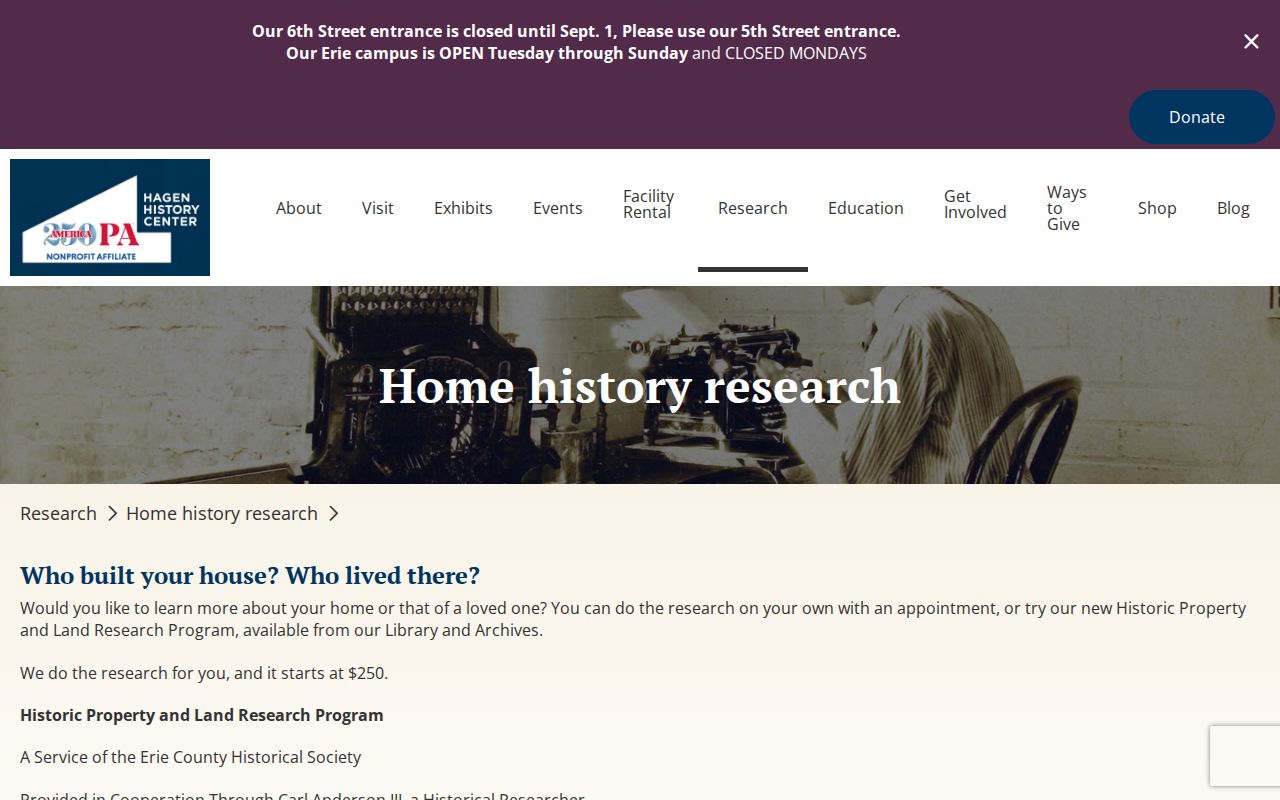
Use that service when a directory clue must be checked against title and place history through documented sources. Keep the edition date and original wording with the request, especially where historic street sides or cross streets are involved.
Note: Hagen’s service supplies research context, while the Recorder and other custodians remain responsible for their own records and copies.
Erie Directory Limits to Check
Several important details remain deliberately unclaimed. The reviewed ECPL pages do not provide a complete city-directory year-by-year run, a confirmed Erie criss-cross directory series, or a facsimile of a full individual entry. The safe next step is to ask the Heritage Room about a named year, title, or address question and inspect the authorized volume, microfilm, or database. Do not turn a historical entry into a present-residence claim, and do not silently bridge old and current address forms without deed, legal-description, map, or official municipal support.
The same restraint applies to an entry’s abbreviations and household details. The reviewed public sources confirm the broad Atkinson’s formats and some Hagen place references, but they do not support publishing an Erie-specific model that assigns meanings to every abbreviation or predicts which personal fields appear in a given year. Photograph or transcribe the edition’s own key where permitted, cite the page, and describe only what it actually shows. If the question is property chronology rather than a printed reference, the Recorder, ECPL, and Hagen each contribute a different part of the evidence trail.
For a non-judicial Erie County agency record that is not otherwise restricted, use Erie County’s Right-to-Know request route with a defined record type and time period. Judicial, vital, adoption, and other protected records use separate custodian rules. That distinction keeps a request focused and respects the access boundary each collection carries.