
Start an Erie Residents Directory Search
An Erie residents directory search works best when it begins with a clear question. For a current place, use the Erie County property route to establish the parcel and its displayed address. For a past household, start with the dated collection that fits the period. For a court, estate, or marriage question, ask the custodian that keeps that record. These paths are deliberately separate. A parcel result, a directory listing, and a docket each describe different evidence and none alone establishes a current residence or identity.
Keep a simple research note as you go: the address wording or name spelling entered, the source, the record date, and the access limitation. Erie sources can use a street address, parcel number, legal description, recorded-document citation, or a directory's period wording. When names or address forms conflict, retain the conflict rather than joining records into a single claim.
- Enter an Erie street address in the Erie County property search to identify the place and parcel context.
- Save the returned address form, parcel number, taxing context, and the date you checked it.
- For a recorded-land question, take those place details to the Erie County Recorder of Deeds or its authorized access route.
- For an earlier household or street form, consult an ECPL directory, map, newspaper, or archive source for the relevant period.
- Use the Erie County, court, State, or archive custodian when a record is not online, gated, or restricted.
Check Erie Court Records Through UJS
The Pennsylvania UJS Web Portal is the public statewide route for court dockets. Its documented public search options include court selection, docket-number and other-criteria modes, and criteria such as organization, name, date of birth, participant role, county, docket type, case category, case status, and filed-date range. A result may show a docket number, court or county, caption or participant label, category or status, filed date, and court-provided docket-sheet materials where available.
Those labels matter. A docket is a court record index and not a factual narrative or a current-residence confirmation. Remote visibility changes with judiciary policy, case type, confidential material, sealing, expungement, and limited-access rules. For permitted file material or questions about Erie records, use the Clerk of Courts for criminal matters, the Prothonotary for civil matters, or another listed court custodian rather than treating a missing web result as proof of absence.
The UJS Portal image documents a neutral court-search entry route without running a person-specific query.
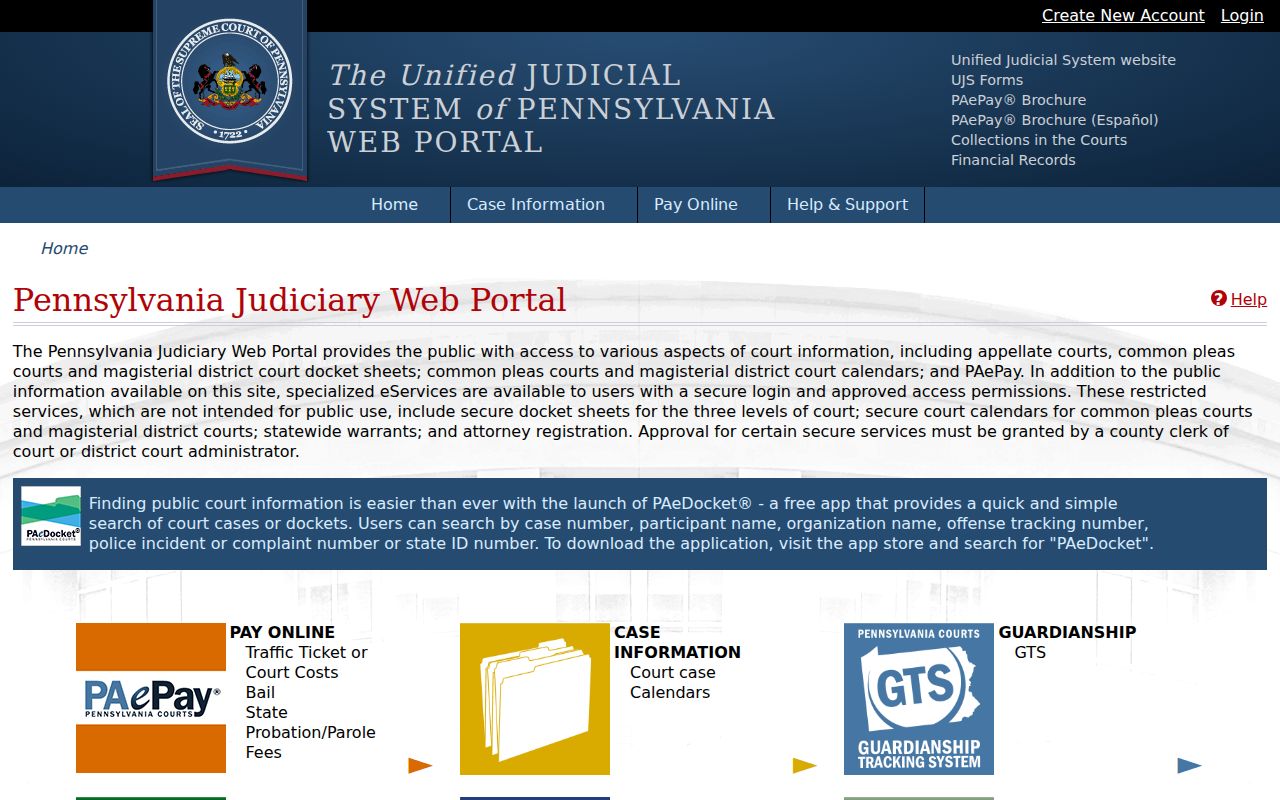
Use the portal's own record vocabulary and consult the court's published policy before relying on a docket display.
Erie Vital and Estate Record Paths
Vital and family-history research in Erie has date and eligibility boundaries. The Erie County identifies City births from 1888 to 1905 and City deaths from 1894 to 1905 at Hagen History Center. It directs Erie County births and deaths from 1893 to 1905 through the Clerk of Records. Erie County marriage records reach from 1885 forward through the Marriage Records office, while probate is stated as 1823 forward through the Register of Wills. These are custodian holdings and request paths, not assurances of a searchable name record.
Pennsylvania Department of Health services current birth and death certificates from 1906 forward. The State requires the proper application, identification, payment, and eligibility. A name and date are not enough to establish access. The Erie public office is part of the State's official public-office network. For older material, consult the State Archives or the local route appropriate to the event date. Adoption material remains especially restricted: the Register of Wills states that adoptions are impounded or sealed by law.
The Pennsylvania Vital Records public-office page provides the current official Erie-office routing information.
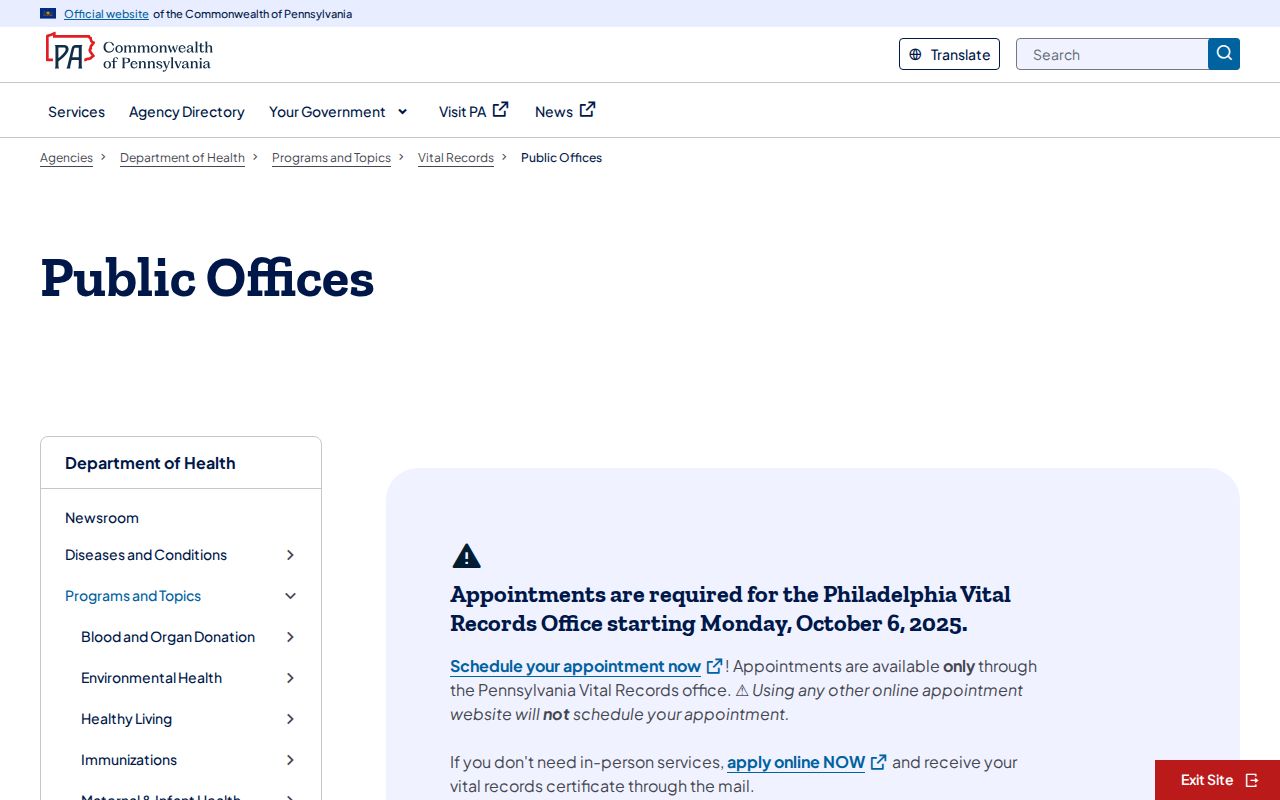
Check the State page before travel because hours, same-day conditions, and eligibility details can change.
Erie Residents Directory Custodians
Erie County keeps place, instrument, court, estate, marriage, and election functions with different offices. Assessment is the starting point for a parcel and tax-context question. The Recorder is the custodian for recorded land instruments. The Clerk of Courts and Prothonotary route criminal and civil material, while the Register of Wills handles probate and the Marriage License Bureau handles its own records. Erie residents directory research becomes more reliable when the request goes to the right custodian first.
Erie County Recorder of Deeds
140 West Sixth Street, Room 121
Erie, PA 16501
814-451-6246
Erie County Assessment
140 West Sixth Street, Room 104
Erie, PA 16501
814-451-6225
Erie County Elections
Erie County Courthouse, Room 112
Erie, PA 16501
Erie County contact directory
Use Erie Property Records by Address
Erie County Property Tax Search is a place-first tool. Its address route asks for a house number, an optional street direction, and a street name, with match modes for the number and street. Erie County instructions say to omit a suffix such as Street or Road and include a direction when it matters. The same property area links toward parcel-number, transfer, and map routes. That makes it a sound beginning for an Erie location question, not a general name search.
| Erie County control | How Erie uses it | Research note |
|---|---|---|
| House Number | Start a street-address query | Use the supplied number and match mode. |
| Street Direction | Distinguish directional street forms | Enter it when applicable. |
| Street Name | Locate a place record | Omit the suffix under Erie County instructions. |
| Parcel Number | Open a parcel-focused path | Use exactly 14 numerals with no spaces. |
The open result layer can provide parcel, situs or property-address, taxing, transfer-navigation, and map-navigation context. It does not provide owner information in the ordinary public display. The Erie County describes a separate qualified registration, professional-membership, and payment condition for that data. Preserve the distinction among a situs address, a mailing address, and a property description instead of treating any address as a confirmation of a person's present location.
The official Erie County Property Tax Search shows the safe address-entry and property-map context used for Erie research.
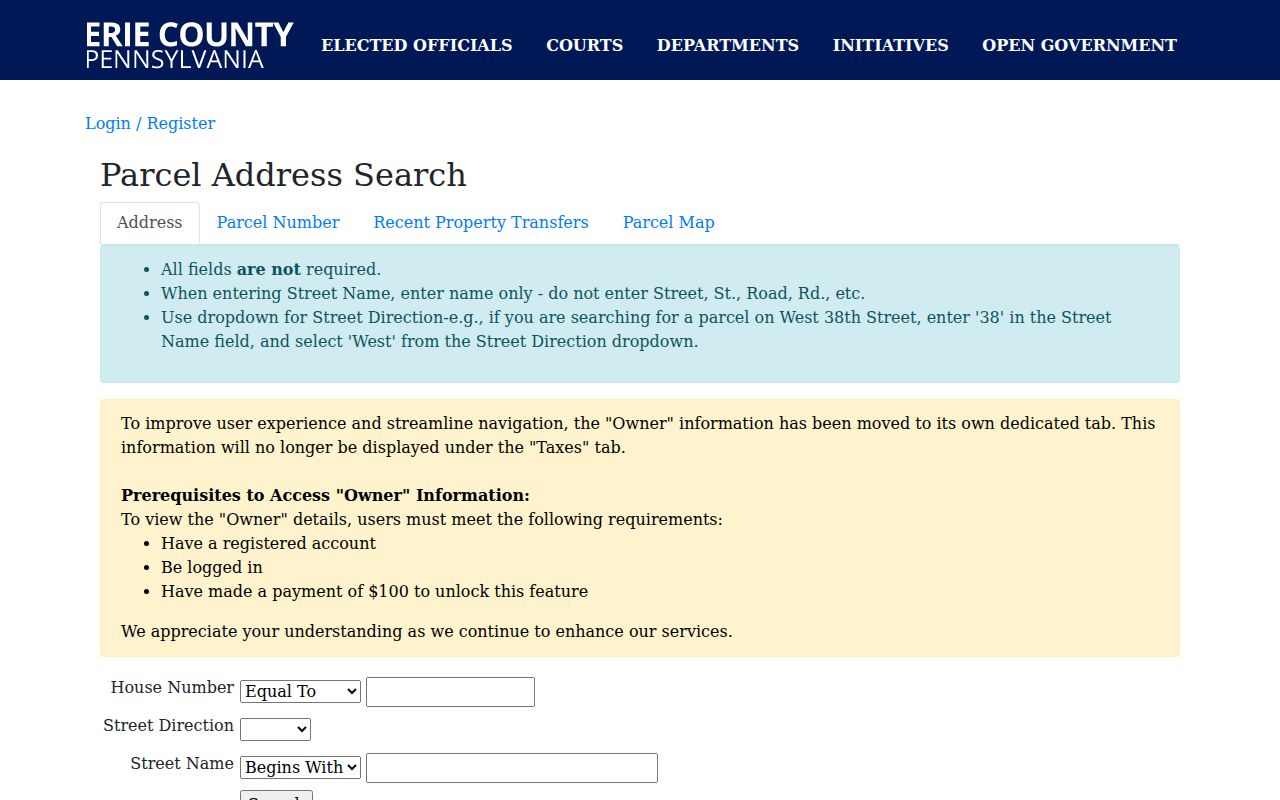
The controls help establish the place and source path, while the displayed access limit keeps an Erie residents directory from presenting a parcel hit as a personal profile.
Erie Parcel Terms Keep Sources Straight
Parcel work is most useful when each field stays in its own lane. The Erie County correction form uses terms such as district, map, block, parcel, property description, owner, and mailing address. Those terms are administrative vocabulary, not interchangeable proof. A parcel number identifies a property-record path. A legal description is the wording used to identify land in instruments. A mailing address may serve an administrative purpose different from the physical situs.
- Parcel
- An Erie County property identifier used to organize the tax and property record path.
- Situs address
- The physical property address shown in a property context, which is distinct from a mailing address.
- Legal description
- Land-identifying language carried in recorded documents and useful when street wording changes.
- Index
- A finding aid to a record, not the record image or a conclusion about a person.
When a property question reaches a document, take the parcel or legal-description details to the Recorder. The office records deeds, mortgages, satisfactions, powers of attorney, leases, UCC filings, and related instruments. Its records are indexed and scanned, but the linked INFOCON service is fee-based for subscribers. The office route or the Erie County's published paid staff-search option is the documented fallback when online access is not enough.
Current Erie Residents Directory Routes
There is no verified City-operated Erie resident roll. Current Erie research instead uses source-specific routes. Erie County property records orient a place. The Recorder supplies instrument access. The UJS Web Portal supplies court dockets under judiciary policy. The Commonwealth's voter tool helps a person check an individual registration status, while the formal voter-list process is controlled by election law and certification. Each source is limited in purpose, coverage, and access.
| Erie source route | What it can establish | Custodian | Access note |
|---|---|---|---|
| Property address and parcel search | Place, parcel, tax, transfer, and map navigation | Erie County Assessment | Base search is public; owner display is gated. |
| Recorded instruments | Document citations and instrument history | Recorder of Deeds | Office viewing/copies or subscriber INFOCON access. |
| Individual registration status | A specific person's official status check | Pennsylvania elections system | Not a public roster. |
| Public court dockets | Court-provided case and filing information | Pennsylvania judiciary | Subject to remote-access policy and restrictions. |
| Historic directories and newspapers | Dated people and place references | ECPL Heritage Room | Many materials are on-site or card-restricted. |
Use the route that matches the question. A parcel query may clarify an address form. A Recorder citation may clarify a recorded land event. An old directory or obituary reference needs its edition or publication date retained. An individual voter-status check does not convert into an Erie resident roster. When the goal is to verify one specific record rather than a place, the Erie resident lookup route keeps the custodian and record type distinct.
Historical Erie Residents Directory Leads
The Erie County Public Library Heritage Room at Blasco Memorial Library is the key local shelf for historical Erie residents directory research. Its Erie city directories begin in 1853, while suburban and Millcreek directories begin with the 1957 edition. The collection also includes newspaper microfilm from 1820 through 2018, census material, maps and atlases, yearbooks, and local-history databases. The materials are noncirculating and many access routes are on-site or card-restricted, so confirm a specific edition or database before relying on it.
A directory entry is dated evidence. It can preserve a period spelling, address, business or occupation context, and neighborhood sequence, but it does not establish present residence or identity. The ECPL catalogue describes Atkinson's Erie City Directory as an alphabetical listing with classified business and local-statistics sections. The full annual run and a verified reverse or criss-cross run were not established in the reviewed sources. For the collection methods, rather than a generalized street list, use the Erie city directory research path.
Read Erie Streets in Their Own Time
Historic Erie addresses may use a street side, a block, a direction, or a cross-street reference that does not fit a current address form. Hagen History Center's local-history material gives examples tied to Myrtle, Eighth, Seventh, Sassafras, and a 1912 State Street block. Record the wording as it appears in the source before trying to align it with a current parcel. The county property system, a legal description, and a dated map can then be compared without silently converting an old description into a new one.
The Library of Congress Erie Sanborn collection supplies dated map layers for 1888, 1900, 1921, and 1950. Note the edition, volume or sheet, block face, street label, and visible structure before making a comparison. A historic map is evidence about its own date, not a current parcel or population record. Hagen's appointment-based home-history service offers another route for title, ownership years, property description, construction year, and neighborhood context.
Erie Records and an 1823 Fire
Erie County's published history places its first courthouse around West Perry Square in 1808 and reports a destructive fire in 1823. The Erie County later developed the Sixth Street courthouse complex through an 1852 office structure and later additions. That history does not show which individual records survived. It does explain why an Erie historical inquiry should ask the relevant office, archive, or library about a record's survival, format, and location instead of assuming one continuous local run.
Several early anchors are still useful, with care. Erie County guidance places Register of Wills probate access from 1823 forward, and the FamilySearch catalogue identifies Erie deed books beginning in 1823 through 1886 along with early grantor/grantee index ranges. ECPL's newspapers begin in 1820 and city directories in 1853. Their overlap creates a time-bounded trail for family history and property context, but each source must retain its original date and limitation.
Route Erie Records Requests Correctly
Pennsylvania's Right-to-Know Law, 65 P.S. §§ 67.101–67.3104, covers many executive and local-agency records. It does not override the separate access rules for courts, vital records, investigative material, and protected personal information. A useful Erie request identifies the agency or custodian, the defined record set, the time period, the preferred delivery method, and contact information. Asking for a particular document or file range is more likely to reach the right office than a broad request about a person.
The Erie County Right-to-Know request page is the Erie County route for non-judicial agency records. Published Commonwealth guidance says agencies generally respond within five business days, with an interim response able to extend the final answer under the law. Fees and prepayment rules may apply. Court files require court access rules, and Recorder or other statutory systems may have their own fee and request practices.
The official Erie County RTKL page shows the request-routing context used for a defined Erie County agency record.
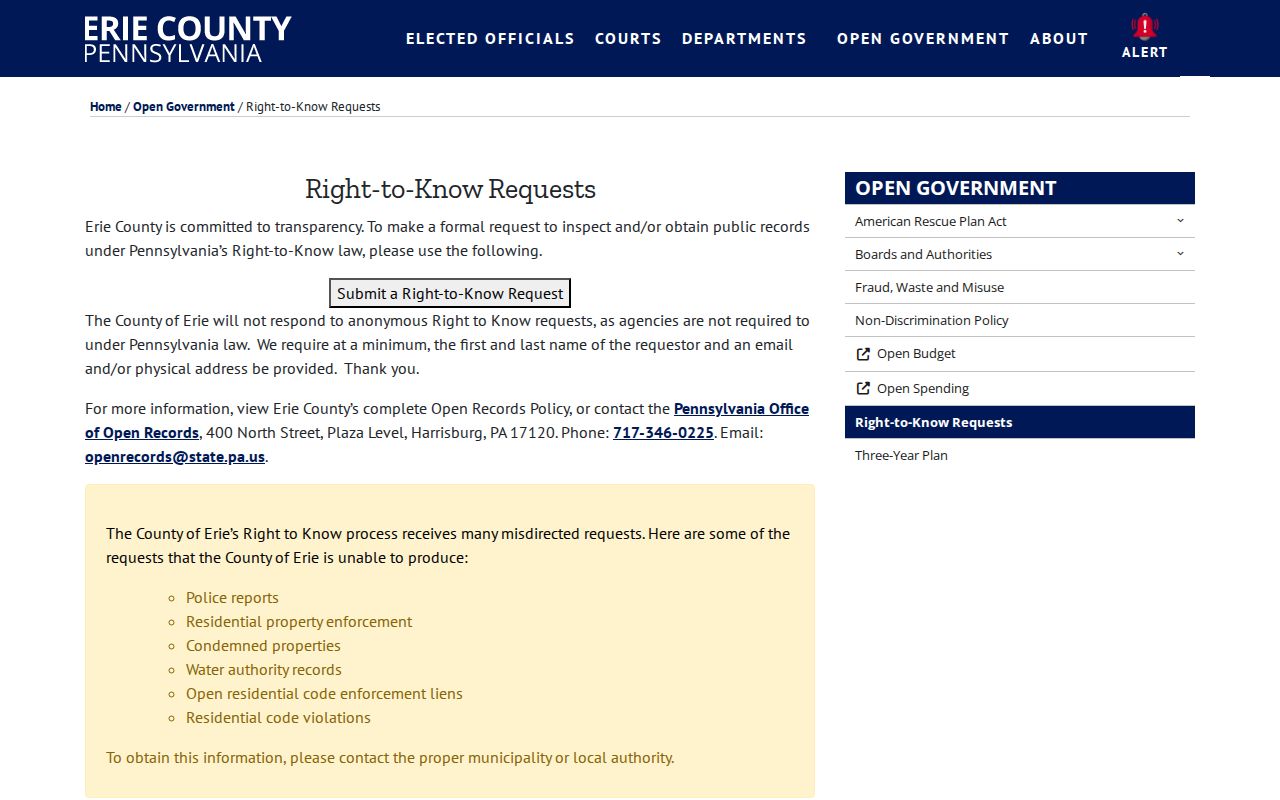
Routing a request to the proper agency preserves the boundaries that separate public agency records from court and protected files.
Protect Erie Residents Directory Boundaries
Erie research should stay place-first, source-cited, and easy to correct. Do not turn a name in a voter request, court docket, registry, license record, or archive into a composite profile. Do not publish full birth dates, signatures, identification numbers, completed forms, protected contact information, or sealed material. A public route is not permission to republish or combine what it may return. The safest result can be a source link, a date, and an access note rather than a claimed personal answer.
The Erie County has a Property Record Correction form for its records, while court, vital, and election records follow their own correction processes. Eligible participants who need a protected mailing route can consult Pennsylvania's Address Confidentiality Program. No universal statewide data-broker deletion system was located in the official sources reviewed.
The Pennsylvania judicial public-record policies explain why court access, confidentiality, and remote visibility require separate treatment.
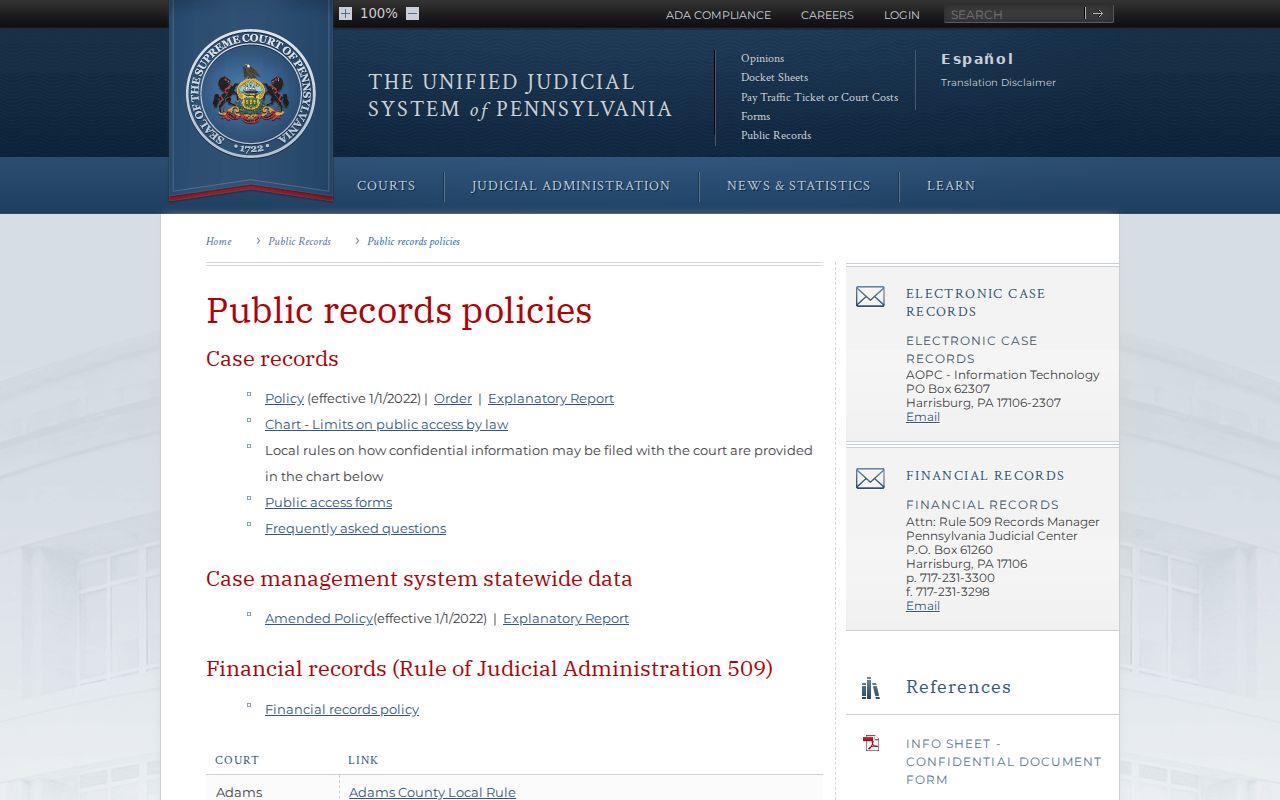
Policy-aware research keeps a restricted record from being mistaken for a missing one or for material that can be republished.